What is Dry Needling?
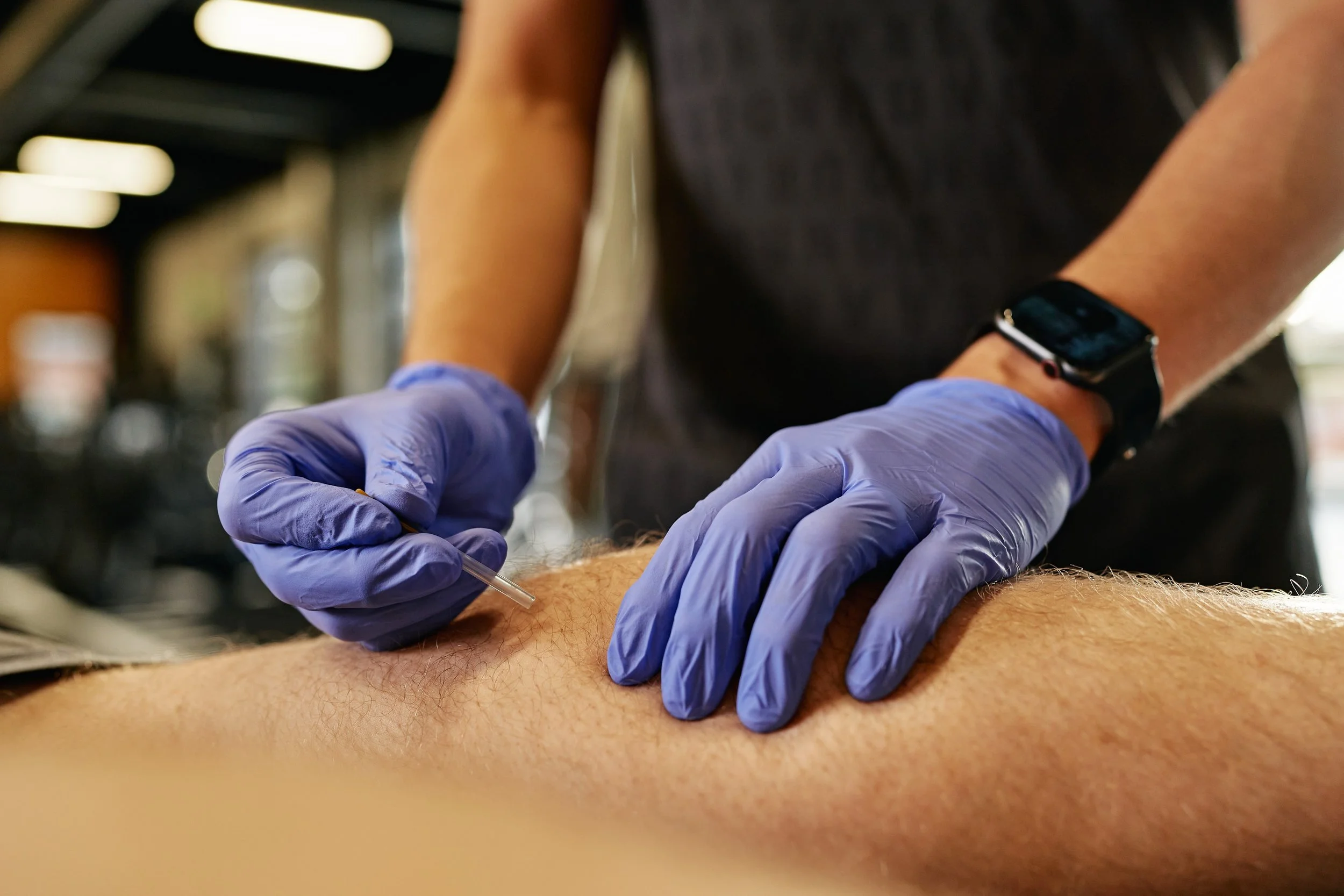
Dry needling helps reduce pain, improve muscle function, and restore movement by targeting tight, irritated muscles and trigger points.
What Does Dry Needling Do?
If you’ve ever been told you have “tight muscles,” “knots,” or “trigger points,” you may have heard dry needling mentioned as a treatment option. For some people, it sounds intimidating. For others, it sounds like acupuncture. And for many, it raises the question:
What does dry needling actually do?
At Art of Physical Therapy, dry needling is one of several tools we use to help people move better, reduce pain, and return active adults and athletes to the activities they care about. When used appropriately, it can be a powerful way to calm overactive muscles that are limiting function.
Let’s break it down clearly.
What Is Dry Needling?
Dry needling is a skilled physical therapy intervention that uses a very thin, solid needle to target myofascial trigger points within a muscle.
A trigger point is a hyperirritable spot in muscle tissue that often:
Feels like a taut or tight band
Is tender to the touch
Reproduces the patient’s specific pain when pressed
Limits the range of motion
Causes the patient to move differently to avoid discomfort
The needle used in dry needling is extremely small, about one-quarter the size of a flu shot needle, and contains no medication. The term “dry” simply means nothing is injected.
What Does Dry Needling Do in the Body?
From a physical therapy perspective, dry needling helps by addressing muscle dysfunction rather than just symptoms.
When a needle is inserted into a trigger point, it can:
Reduce excessive muscle tension
Improve local blood flow
Decrease pain sensitivity
Restore normal muscle activation
Allow the muscle to lengthen and contract more effectively
In simple terms, dry needling helps “reset” a muscle that has been stuck in a protective or overactive state.
That muscle response often creates a window where movement, strengthening, and retraining become far more effective, which is why dry needling is rarely used alone.
Conditions that Respond Well to Dry Needling
Dry needling is most effective for musculoskeletal conditions, especially those involving muscle guarding, overuse, or altered movement patterns.
At AoPT, we commonly use dry needling for conditions such as:
Knee pain and patellar tendinitis
IT band syndrome
Glute pain and sciatic-type symptoms
Swimmer’s shoulder and shoulder impingement
Low back pain
Hip pain
Achilles pain
Tennis elbow and golfer’s elbow
Tight calves from running
Muscle strains (hamstrings, quads, calves)
Dry needling may also be used before surgery, such as ACL or shoulder procedures, to reduce muscle guarding of surrounding areas and improve movement, or as part of conservative care when surgery is not immediately necessary.
When Dry Needling Is NOT the Right Tool
Dry needling is not appropriate for every condition or every person.
It is typically not recommended for:
Acute fractures
Recent surgical sites
Full-thickness tendon ruptures
Significant labral tears affecting stability
Certain systemic inflammatory or neurological conditions
Individuals who do not tolerate needles well
In these cases, we may use other interventions such as manual therapy, cupping, mobility work, or exercise-based rehab instead.
The key point: dry needling is never automatic. It is chosen intentionally after a full evaluation.
Is Dry Needling the Same as Acupuncture?
This is one of the most common questions we hear and the answer is no.
While both use similar needles, their philosophies and purposes differ.
Acupuncture is rooted in Eastern medicine and focuses on restoring balance, or “Qi,” through the meridians.
Dry needling is based on Western medical principles and targets specific muscles and trigger points to improve movement and reduce pain.
The American Physical Therapy Association defines dry needling as:
“A skilled intervention that uses a thin filiform needle to penetrate the skin and stimulate underlying myofascial trigger points, muscular, and connective tissues for the management of neuromusculoskeletal pain and movement impairments.”
Do You Recommend Dry Needling for Everyone?
Not automatically.
At Art of Physical Therapy, we determine whether dry needling is appropriate only after a full evaluation, where we review or assess:
Your medical history
Your current pain and limitations
Your movement patterns
Strength, mobility, and palpation findings
Your personal goals
If dry needling fits your presentation and comfort level, it can often be performed on the same day as your initial evaluation. If not, we choose another approach that better matches your needs.
What Does a Typical Response Look Like?
Many patients notice:
Immediate changes in movement
Reduced tension or pain after the first session
Temporary soreness similar to a workout
Faster recovery between training sessions
Athletes and active adults often report that dry needling helps them recover more efficiently and tolerate higher training loads when combined with proper rehab.
A Real-World Clinical Example
An active adult presented with persistent lateral knee pain that limited running and squatting. The evaluation revealed significant trigger points in the lateral quad and gluteal muscles, along with altered movement mechanics.
Dry needling was used to address those trigger points, followed by targeted mobility and strengthening exercises. After a few sessions, the patient reported reduced pain, improved squat depth, and returned to running without symptom flare-ups.
The key factor was not the needle alone, but how it allowed us to restore normal movement patterns.
Common Myths and Fears About Dry Needling
It’s normal to have questions or concerns before trying dry needling. Here are some of the most common ones we hear:
“Is it going to be painful?”
Most people barely feel the needle enter the skin. When a sensation is felt, patients often describe it as a brief cramping, twitching, or dull ache. If you feel uncomfortable at any point, we remove the needle immediately and either adjust the location or use a different treatment approach altogether.
“What if the needle hits a nerve?”
There are small superficial nerves in the skin that can create a temporary uncomfortable sensation, but this does not cause nerve damage. If that happens, the needle is removed right away. When working near larger nerves (like the sciatic nerve), we use detailed anatomical knowledge, palpation, and safe positioning to avoid sensitive structures.
“Is dry needling dangerous?”
Serious complications are very rare. One uncommon but more serious risk is a pneumothorax (collapsed lung) when needling near the rib cage or upper back.
Signs and symptoms of a pneumothorax include:
Difficulty taking a deep breath
Chest pain
Dry cough
Shortness of breath, especially with activity
If these symptoms occur, medical evaluation is required immediately. Other mild side effects may include temporary soreness, bruising, bleeding, or feeling lightheaded after treatment.
“Is this the same as acupuncture?
See our answer from above :)
How Dry Needling Fits Into Physical Therapy
Dry needling is not a standalone fix.
It works best when combined with:
Manual therapy
Mobility work
Strength training
Movement retraining
Sport- or activity-specific rehab
Think of it as a way to remove roadblocks so your body can move and adapt more effectively.
Final Thoughts
So, what does dry needling do?
It helps calm overactive muscles, reduce pain, restore movement, and create an environment where real rehab can happen. When used appropriately and combined with skilled physical therapy, it can be a powerful tool for recovery and performance.
If you’re curious whether dry needling is right for you, book your first appointment at Art of Physical Therapy today!